Executive summary
The KiKiallus Nation is a sovereign indigenous nation of the Lushootseed-speaking Coast Salish peoples of western Washington. Primary documentary evidence establishes continuous existence and historical legitimacy for legal, governmental, and financial compliance review.
-
Treaty recognition. Named as “Kik-i-allus” in the
Treaty of Point Elliott
(January 22, 1855; 12 Stat. 927), ratified March 8, 1859. Signing delegate: Sd-zo-mahtl (Sdzomahtl).
Archive copy ·
UW Digital Commons ·
Suquamish Tribe PDF
-
Judicial recognition of territory. Indian Claims Commission Docket No. 263 final award of $6,026.69 on June 7, 1972 (28 Ind. Cl. Comm. 159), funded by Public Law 92-607 (86 Stat. 1498). Territory mapped as Item #156 on the
Indian Land Areas Judicially Established (1978)
map; BIA replot retained Item #156 in 2015.
-
Federal demographic classification. U.S. Census Bureau race code H72 for Kikiallus American Indians — also in
CDC race/ethnicity codes,
SEER coding manuals, and the
November 18, 2024 Federal Register
proposal for ACS / 2030 Census codes (89 FR 91205).
-
State legislative recognition.
Washington State Senate Resolution 8672
(2003, Sen. Haugen) honors the Nation and resolves that the name “should be forever acknowledged for the ancestors and descendants of the Kikiallus Nation.”
Archive
-
Continued government-to-government relations. As of March 31, 2025, the Washington State Energy Facility Site Evaluation Council (EFSEC) issued tribal consultation correspondence to the KiKiallus Nation on the Draft PEIS for electrical transmission facilities.
Geographic origin
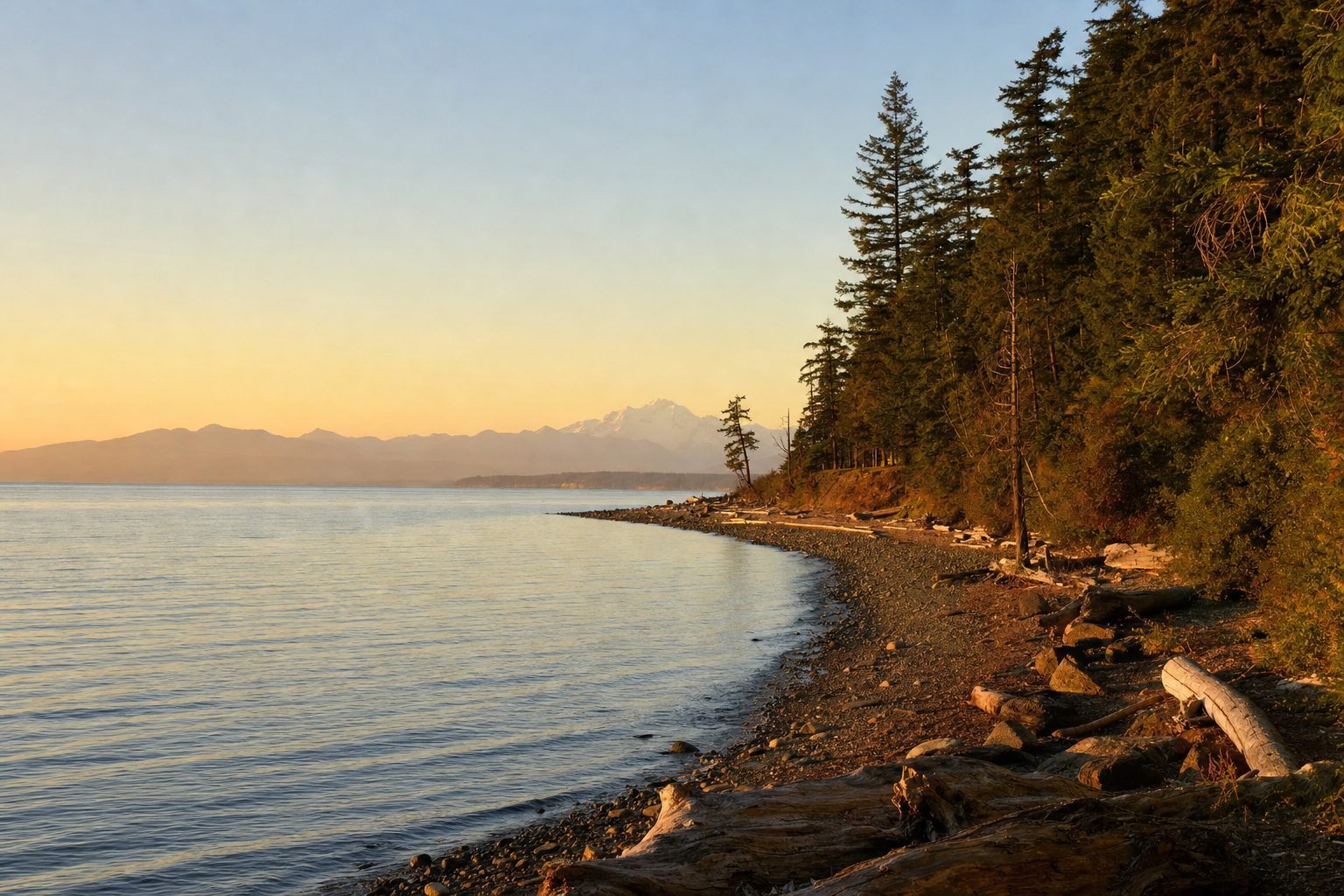
Pre-contact occupancy of the Skagit River Valley (historically the Kikiallus River), northern Camano Island, parts of Whidbey Island, and surrounding coastline — with eight permanent villages documented in state and NPS ethnohistory.
North Cascades NPS ·
Ebey’s Landing ethnohistory (Deur 2009) ·
Utsalady village (Sound Water Stewards)
Villages and settlements included the Fir–Conway area south of present-day Mount Vernon, Jim Creek, Penn Cove, Utsalady Bay, the south fork at Carpenter Creek, and seasonal ranges to the Stillaguamish and beyond.
Treaty of Point Elliott (1855)
The preamble names the Kik-i-allus among allied and subordinate tribes. Article 5 reserved fishing at usual and accustomed grounds and stations, and hunting and gathering on open and unclaimed lands. The treaty remains the foundational instrument of the Nation’s government-to-government relationship with the United States.
Roblin Rolls & claims testimony
In the late 1910s the Office of Indian Affairs directed Special Agent Charles E. Roblin to schedule non-reservation Indians of Western Washington who had not been enrolled on reservation rolls. The resulting Roblin Rolls (commonly dated 1919) are a primary federal record of off-reservation Kikiallus families and individuals and remain a standard reference in enrollment, descent, and historical continuity work.
Claims-era testimony supplements those rolls. On March 8, 1927, at the Swinomish Indian Reservation, the deposition of John Lyon (Lyons) was taken in connection with land-claims and tribal-identity questions affecting Kikiallus people. Together, the Roblin Rolls and the 1927 claims testimony document continuous Kikiallus presence after treaty time among both reservation-associated and non-reservation lines.
Historical population estimates drawn from treaty-period sources and later claims testimony held roughly 150–180 members. Those figures are descriptive of the documentary record; they are not a modern census of the Nation.
Claims and ICC Docket 263
From 1951 through 1972 the Kikiallus Tribe prosecuted Docket 263 before the Indian Claims Commission. Final award June 7, 1972; attorneys’ fee findings August 28, 1974 (34 Ind. Cl. Comm. 442). Judgment-fund enrollment is addressed under
25 CFR Part 61.
ICC indices:
NARF index ·
ICC final report
Swinomish confederation context
Documentary sources identify the KiKiallus as an independent sovereign confederation member among the four constituent groups associated with the Swinomish Indian Tribal Community (with Swinomish, Lower Skagit, and Samish). A 1982 U.S. Department of the Interior Federal Acknowledgment decision regarding the Samish references the KiKiallus independently as residents of the Swinomish Reservation.
Descendants & language
Many families on the Swinomish and Tulalip Reservations carry Kikiallus ancestry. The traditional language is a dialect of Lushootseed; English is used in civic life, with Lushootseed retained in ceremony and revitalization. Citizens today live across the Pacific Northwest and beyond; many remained off-reservation after 1855. Off-reservation lines appear on the Roblin Rolls; reservation-associated and claims-era identity is further supported by the 1927 John Lyon (Lyons) deposition and later ICC Docket 263 materials.
Modern governance markers
Certificate of Incorporation February 19, 2002 (then Chief and Judge Douglas P. Lavan). Partial land-claim payment recorded in 1998. The Nation maintains Tribal Council, Office of the Chief, Allied Court, Central Records, and the Sovereign Oversight Board.